
PDM: Regionalization, Nearshoring and Reshoring of Supply Chains
ASCM Toronto Members: $5.00 + HST =$5.65 
Non-Members and Guests: $20.00 + HST = $22.60 
Presentation Outline
The history of supply chain management has been one of evolution mixed with revolution. Ever since Keith Oliver’s first use of the term in a 1982 Financial Times article, supply chains have changed considerably. Beginning in the 1980’s and1990’s several revolutions occurred making transformative changes to Supply Chain Management. The first was offshoring. This benefitted western manufacturers greatly as China enjoyed labor rates that were a fraction of those in the West yet had the technological capacity and investment capital coming primarily from the Chinese government to build the infrastructure required to meet these new market demands.
Between 1993 and 2001 the world’s standard of living increased significantly as globalization spread around the world. The biggest winners have been in Asia, notably
China and India. But as with most periods of prosperity, there were winners and losers. Those that lost the most were the US workers whose jobs were lost to offshoring the
manufacturing jobs that had previously been theirs. Between 1979 and 2018, total manufacturing jobs in the US had shrunk from 19 million to 12.8 million. Middle
America, once known as the Steel Belt, became known as the Rust Belt for all its empty and rusting factories.
Then Covid changed everything.
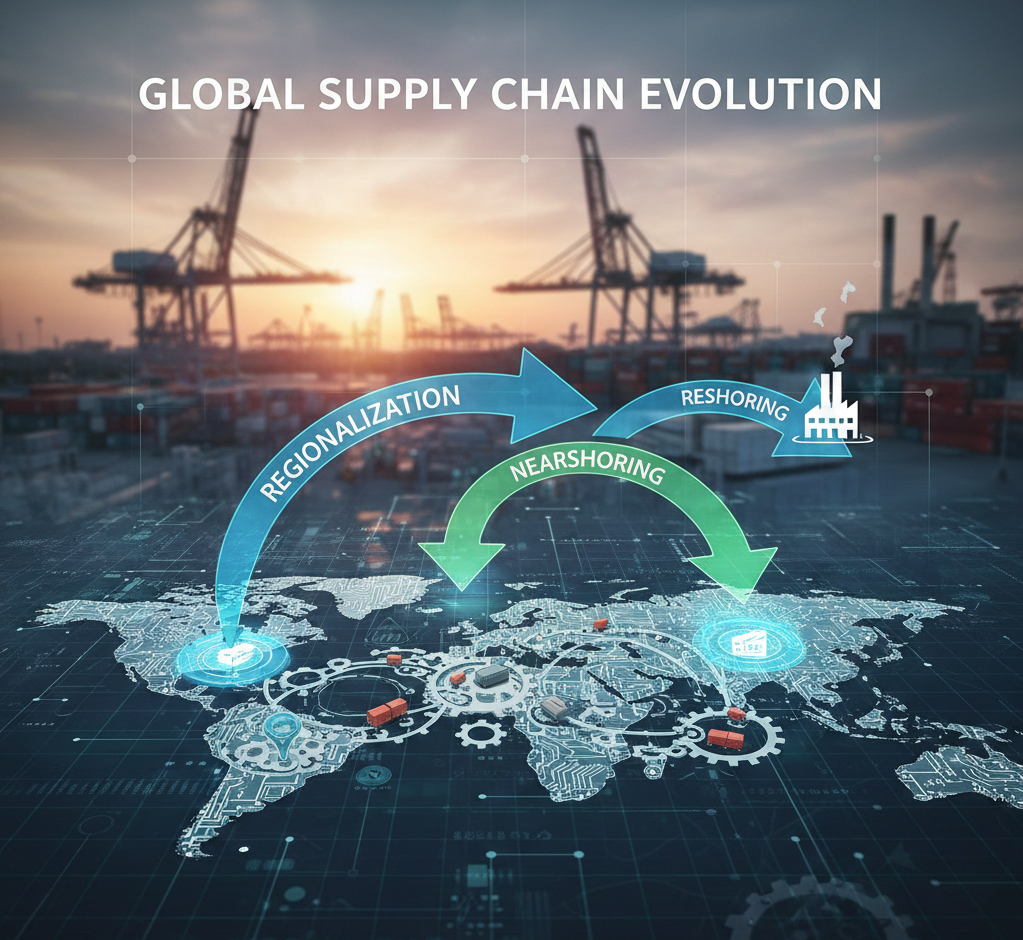
Covid changed how we thought about supply chains. We found that long and complicated supply chains were now fraught with risk. As companies looked towards their supply chains for answers many of them found the answer in three alternatives: Regionalization, Nearshoring, and Reshoring. Regionalization, Near Shoring and Reshoring of Supply Chains by Gary Smith is based on a 4-part series recently published in The Bridge. He will provide some history as to how we got there and will provide some pros and cons of Regionalization, Nearshoring and Reshoring as supply chains grapple with how they can adapt to the future.
Gary A. Smith, CPIM-F, CSCP-F, CLTD-F

Gary A. Smith is an Independent Supply Chain Consultant, Author, Speaker, and Adjunct Professor. His forty-plus year career includes leadership positions in warehouse operations and management consulting in a variety of industries and in both private and public sectors. In 2022, Gary retired as Chief, EAM / SCM for New York City Transit (NYCT), where he identified and implemented supply chain concepts, tools, equipment, systems, and best practices as New York City Transit implemented its Enterprise Asset Management (EAM) program, to reduce costs and throughput while improving overall processes. He also served as Vice President of Supply Logistics for NYCT. He also teaches an online course “Business Logistics and Transportation” for Rutgers University. He is the author of numerous articles and white papers on supply chain management and often speaks on the subject at PDMs, conferences and podcasts. He is the author of The Bridge, a biweekly newsletter on LinkedIn with over 1,000 subscribers.
Gary is a graduate of the Georgia Institute of Technology and holds Fellow-level status in three APICS Certifications; Certified in Production and Inventory Management (CPIM), Certified Supply Chain Professional (CSCP), and Certified in Logistics, Transportation, and Distribution (CLTD). He Chairs the CLTD Certification Committee for ASCM and is an ASCM Recognized Instructor. Gary and his wife Liz make their home in Brunswick, GA.
Certification of Maintenance: 1.5 points
Agenda:
6:00 - 6:15 Registration and Networking
6:15 - 7:30 Presentation | Q & A
Price:
ASCM Toronto Members: $5.00 + HST =$5.65
Non-Members and Guests: $20.00 + HST = $22.60
 ASCM is an unbiased partner, connecting companies around the world with industry experts, frameworks and global standards to transform supply chains.